Saturday, March 20, 2010

Rhythms

Beats are very important to learn in order to be able to play. These are the 5 basic types of notes or rests that are used in music theory:


- Whole note or rest=4 beats
- Half-note or half rest =2 beats
- Quarter note or quarter rest =1 beat
- Eighth note or eighth rest=1/2 beat
- Sixteenth note or sixteenth rest=1/4beat


When you see a note, you play it and hear it. When you see a rest, this is equivalent of a silent note in other words you’re not supposed to be playing. The following video gives an idea about the counting principle when playing. It is for an advanced level; however it might be interesting for those who are familiar with music and rhythm.


References for image and video

http://faculty.mcneese.edu/bproksch/theory/rhymet_files/image001.gif
http://www.youtube.com/watch?v=NL7iJirnD1o

Get Started!!!

I give piano lessons for kids aged between 7 and 12 years old. It would be interesting to get an idea about the basics of music. This post and the following will illustrate some of the main features of music annotations.
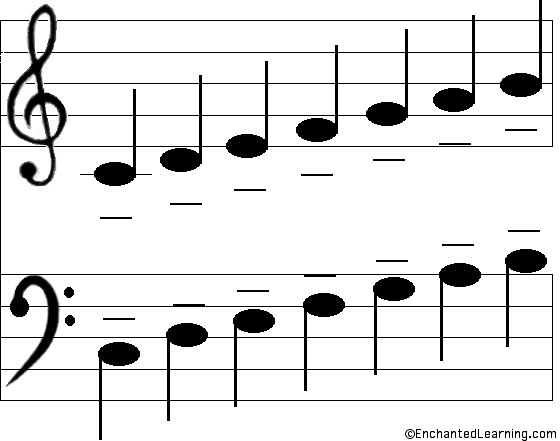
There are 2 types of clefs the treble and the bass clefs. These clefs are necessary to write notes and pieces. They are the backbone of each music piece. There are 7 basic notes: A, B, C, D, E, F, G and we go back to A. Every note has a different position on the treble and bass clefs. There are also flats and sharps (black notes found on the piano). The following video will teach you how to play the C major scale.


The C Scale


Reference for video and image

http://www.youtube.com/watch?v=qPnS6lDL2MA
http://www.enchantedlearning.com/music/label/cscale/label.GIF

Kids and Classical Music

Classical music is not very much spread among young children nowadays. It is one of those types of music that calm the mind and soften the spirit. It is important for every child to get acquainted with such kind of music. Here are some tips given by Hannah Boyd to help parents and educators get the children into classical music:


- Appreciate the music yourself, listen to it frequently
- Try playing some classical instruments (piano, violin…) or even take singing lessons
- Learn about classical composers and share your knowledge with kids
- Watch live/ recorded performances for kids (such as Disney movies) that enhance the ear for classical music


Reference
Hannah Boyd (n.d.). Instrumental learning: get your kid into classical music. Retrieved from http://www.education.com/magazine/article/Classical_Music_for_Kids/

Thursday, March 18, 2010

Vivaldi and Chopin

My two favorite composers are Antonio Lucio Vivaldi and Frederic Chopin.

Vivaldi (1678-1741) was an outstanding Venetian Baroque composer. He received his early music education at home since his father was a violinist. He composed sets of Sonatas for violin. He always aimed at being simple and harmonious.
You can listen to the Four Season, Winter part at: http://www.youtube.com/watch?v=nGdFHJXciAQ


Chopin (1810-1849) is born of a Polish mother and a French father. He relates to both cultures and this is reflected in his compositions. He was a pianist of the Classical and Early emerging Romantic period and composed mainly solo pieces for piano such as Preludes, Etudes, Waltzes, Nocturnes and Mazurkas.


References
1-Classical Net (n.d.). Antonio Lucio Vivaldi. Retrieved from http://www.classical.net/music/comp.lst/vivaldi.php

2-Mfiles (n.d.). Frederic Chopin. Retrieved from
http://www.mfiles.co.uk/composers/Frederic-Chopin.htm

History of Classical Music


It is interesting to know the roots of classical music and from where this type of music emerged. The Medieval (c.1150- c.1400) period was the first period where we started listening to great chants named at that time as ballades and estampies. The Renaissance period (c.1400-c.1600), following the Medieval witnessed more freedom in their music. However music for choirs was written more than instrumental music. The following period: the Baroque (c.1600-c.1750) founded the idea of the modern orchestra along with opera and concertos. All 3 periods preceded the Classical era (c.1750-c.1830), characterized by the dominance of instrumental composition such as symphonies and sonatas.

Reference
The world's leading classical music label (n.d.). Retrieved from http://www.naxos.com/education/brief_history.asp